
Home » Cybersecurity in 2026: Emerging Threats and Smart Defense Strategies for Businesses

Let’s be honest — Cybersecurity is no longer just an IT department problem. It’s a business survival issue. Whether you’re running a startup, a growing tech company, or a large enterprise, ignoring Cybersecurity today is like leaving your office door wide open at night.
In 2026, cybercriminals are smarter, faster, and more automated than ever. The tools they use are powered by AI, machine learning, and deepfake technologies. So if you think basic antivirus software is enough, it’s time for a serious upgrade.
In this blog, we’ll break down the Cybersecurity threats meaning, explore the Top 10 cyber security threats, and share practical strategies to protect your business in 2026.
Before we jump into trends, let’s quickly understand the Cybersecurity threats meaning in simple words.
Cybersecurity refers to the practice of protecting systems, networks, devices, and data from digital attacks. These attacks usually aim to:
Steal sensitive information
Disrupt business operations
Demand ransom payments
Damage reputation
In short, Cybersecurity is about keeping your digital world safe from unauthorized access and malicious activities.
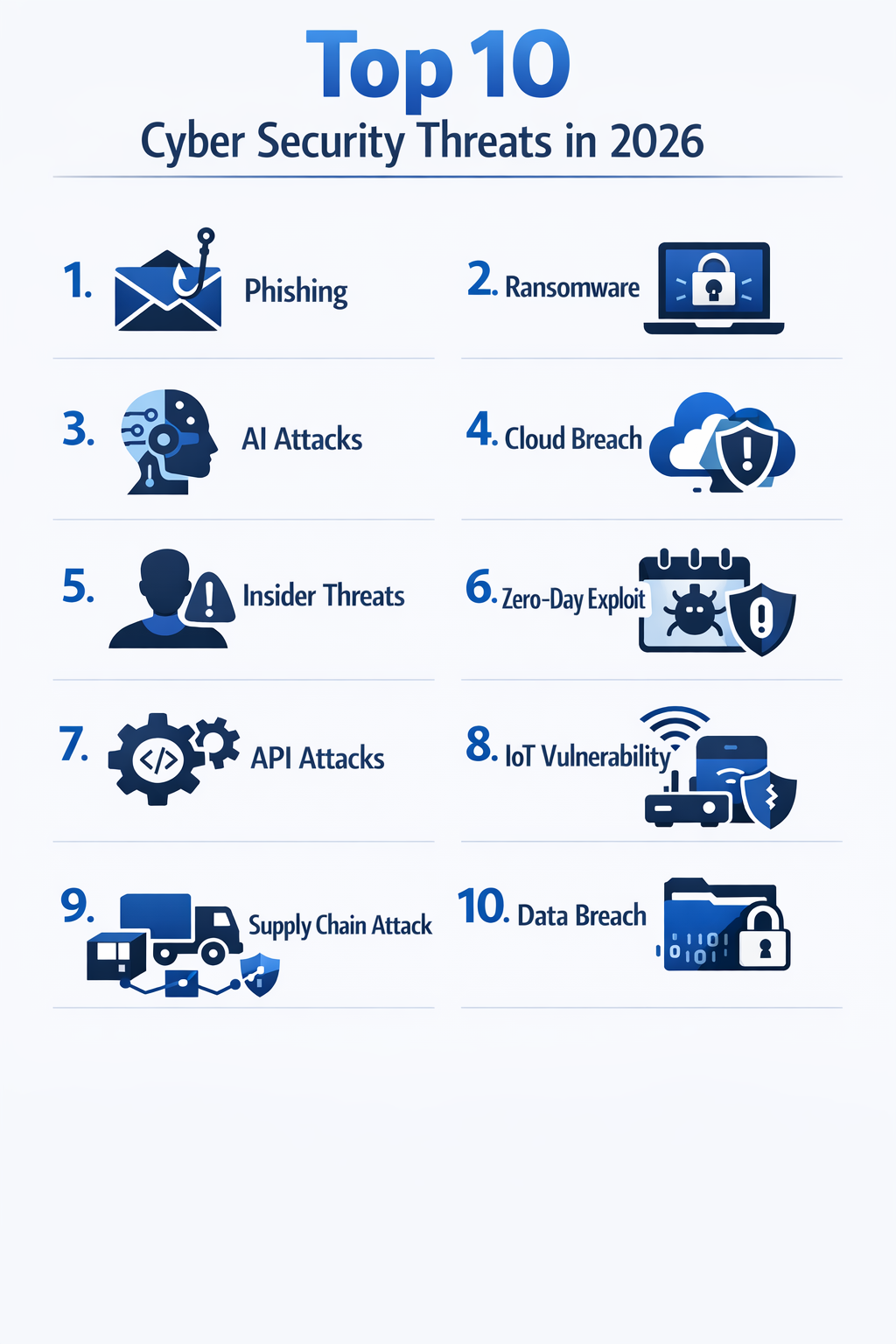
If you’ve searched for “Cybersecurity threats articles” lately, you’ve probably noticed one thing — the number of incidents keeps increasing.
Businesses are now:
Fully dependent on cloud infrastructure
Using remote and hybrid work models
Storing massive amounts of customer data
Integrating AI tools into daily operations
All of this expands the attack surface. That’s why Cybersecurity trends 2026 are focused on proactive defense instead of reactive solutions.
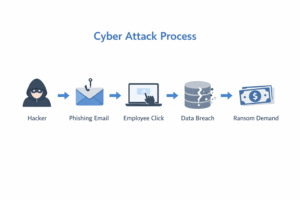
Let’s break down the Top 10 cyber security threats that businesses should actively monitor:
Phishing emails are no longer poorly written scams. Attackers now use AI to craft hyper-personalized emails that look 100% real.
Ransomware is now a business model. Hackers sell ready-made kits, making it easier for anyone to launch attacks.
Deepfake audio and video are being used to impersonate CEOs and executives for financial fraud.
Improper cloud setup remains one of the biggest Recent cyber threats, leading to data leaks.
Attackers target third-party vendors to infiltrate larger organizations.
Smart devices with weak security create easy entry points.
Hackers exploit unknown software vulnerabilities before patches are released.
Not all threats come from outside. Employees (intentional or accidental) can cause serious damage.
APIs power modern apps, but unsecured APIs are becoming prime targets.
Still one of the most damaging issues in Cybersecurity, affecting millions of users worldwide.
Many experts who publish Top cyber threats to watch in 2026 PDF reports highlight these risks as the most critical for businesses.
If we compare Top cyber threats to watch in 2026 2022 predictions with current trends, one big shift stands out — automation.
In 2022, most attacks required manual effort. In 2026, AI tools are:
Scanning systems automatically
Writing malicious scripts
Launching bulk phishing campaigns
Detecting security loopholes faster than humans
This means Cybersecurity solutions also need automation and AI-powered detection systems.
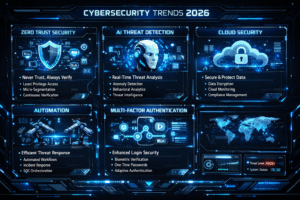
Let’s talk solutions. What are the major Cybersecurity trends 2026 that companies are adopting?
“Never trust, always verify.” Every user and device must be authenticated.
Machine learning systems monitor behavior patterns and detect anomalies in real-time.
Specialized tools designed specifically for hybrid and multi-cloud environments.
Instead of annual audits, businesses now rely on 24/7 monitoring systems.
Human error remains a top vulnerability. Awareness programs are essential.
You might have seen searches like:
Top cyber threats to watch in 2026 PDF
Cyber threats PDF
Cybersecurity threats articles
These reports are valuable because they provide:
Industry insights
Data-backed statistics
Case studies
Real-world attack scenarios
Downloading a trusted Cyber threats PDF report from reputable security firms helps businesses stay informed and proactive.
Looking at Recent cyber threats, we’ve seen:
Large-scale ransomware attacks on healthcare systems
Massive cloud data exposure incidents
AI-generated phishing campaigns targeting fintech companies
Government infrastructure attacks
Each incident highlights the importance of strong Cybersecurity policies.
Now the important part — how do you protect your business?
Here are practical, actionable steps:
Passwords alone are not enough anymore.
Most cyberattacks exploit outdated systems.
Find weaknesses before hackers do.
Both at rest and in transit.
Remote work means more device-level vulnerabilities.
Preparation reduces panic and downtime.
Strong Cybersecurity is not about spending more money. It’s about building smarter systems.
Let’s be real — the cost of ignoring Cybersecurity is huge:
Financial losses
Legal penalties
Reputation damage
Loss of customer trust
Operational downtime
In 2026, customers expect companies to protect their data. If you fail, they move on.
Cybersecurity is not just about tools. It’s about culture.
To build resilience:
Make security everyone’s responsibility
Integrate Cybersecurity into business strategy
Train employees regularly
Stay updated with Cybersecurity trends 2026
Monitor evolving Recent cyber threats
When security becomes part of your company DNA, you reduce risks significantly.
The digital world in 2026 is exciting — AI innovation, cloud expansion, smart automation — but it also comes with serious risks.
Understanding the Cybersecurity threats meaning, tracking the Top 10 cyber security threats, reading reliable Cybersecurity threats articles, and following trusted Top cyber threats to watch in 2026 PDF reports can make a massive difference.
Cybercriminals are evolving. Your Cybersecurity strategy must evolve faster.
If there’s one takeaway from this blog, it’s this:
👉 Cybersecurity is not optional anymore.
👉 Cybersecurity is not a one-time investment.
👉 Cybersecurity is a continuous commitment.
Businesses that prioritize Cybersecurity today will lead confidently tomorrow.
If you’d like, I can now:
Suggest featured image prompts
Create an SEO meta title + description
Provide internal linking strategy
Or optimize this blog further for ranking 🚀


